Investigation of Liquid-Bridges on Designed Structures
BSc Thesis studying the geometry of constant mean curvature surfaces
Intro
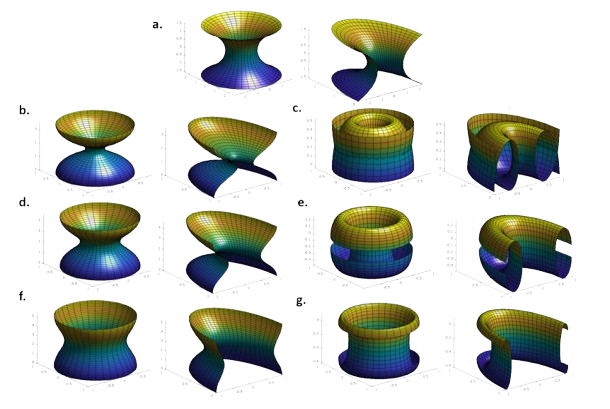
For my thesis, I worked at the Institute for Applied Materials – Microstructure Modelling and Simulation at the Karlsruhe Institute of Technology. My research focused on the geometry of rotation-symmetric constant mean curvature surfaces, such as catenoids, unduloids, nodoids, spheres, and cylinders.
The goal was to validate results produced by PACE3D (Parallel Algorithms for Crystal Evolution in 3D), a simulation software designed for phase transformation processes. This software solves the Allen-Cahn equation, which describe multiphase systems with wetting. One of the many applications, which caught my interest, was the design of water management systems using capillary forces.
Generating Reference Surfaces
While catenoids, spheres, and cylinders are straightforward to generate, unduloids and nodoids require a parametric representation. Based on the work of Mladenov and Hadzhilazova1, these shapes can be parametrized:
Results
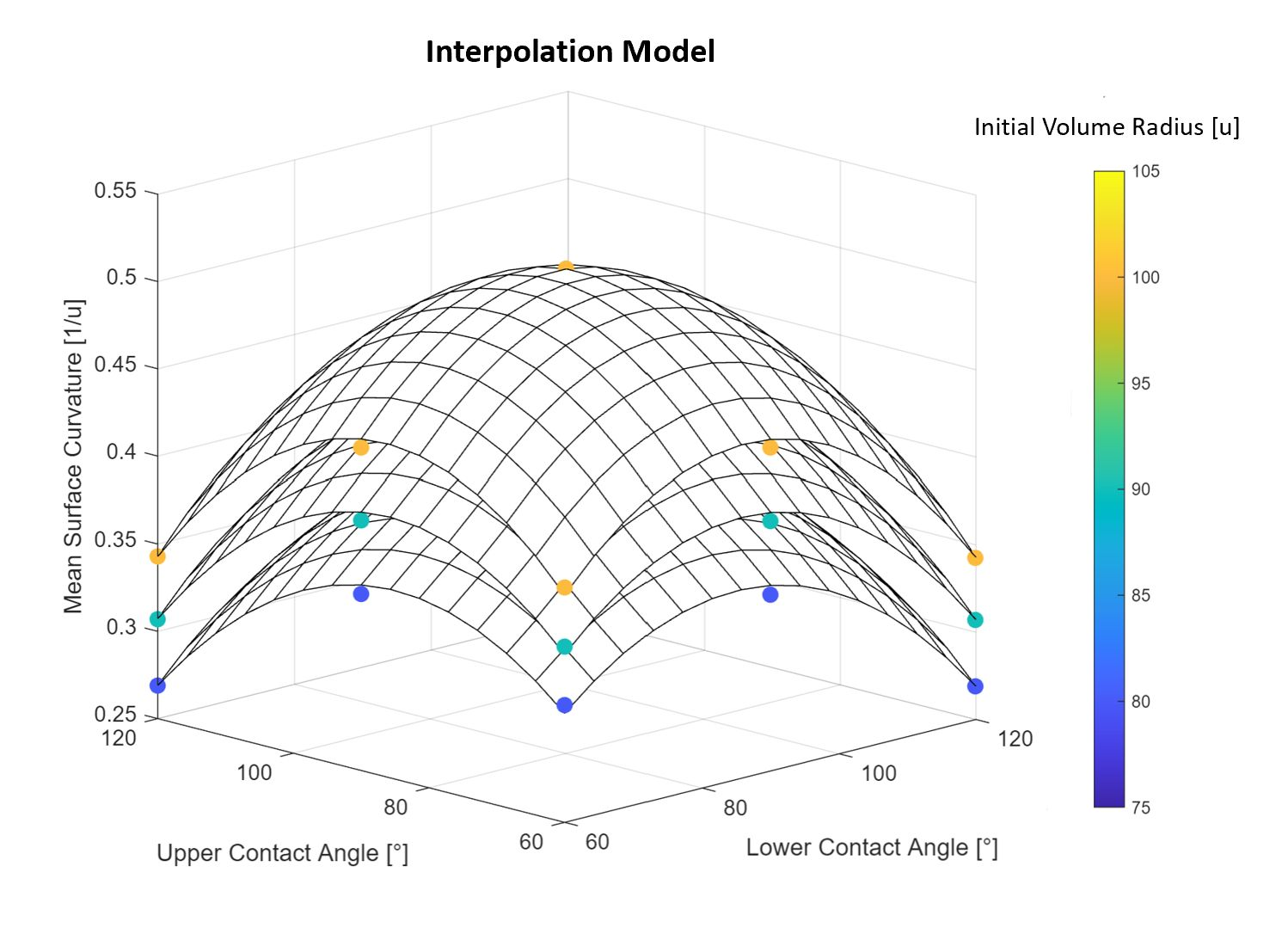
The main task of my thesis was to conduct a parameter study using the simulation setup. I measured the constant mean curvature of the resulting surfaces and matched these with parametrized surfaces to identify the geometric shapes that were formed.
From these results, I developed a response surface model to predict the mean curvature based on the simulation parameters. To test the model, I measured the error using samples that were not part of the original dataset.
Mladenov, Ivaïlo M. and Hadzhilazova, Mariana Ts. and Oprea, John (2007). Unduloids and Their Geometry ↩︎